
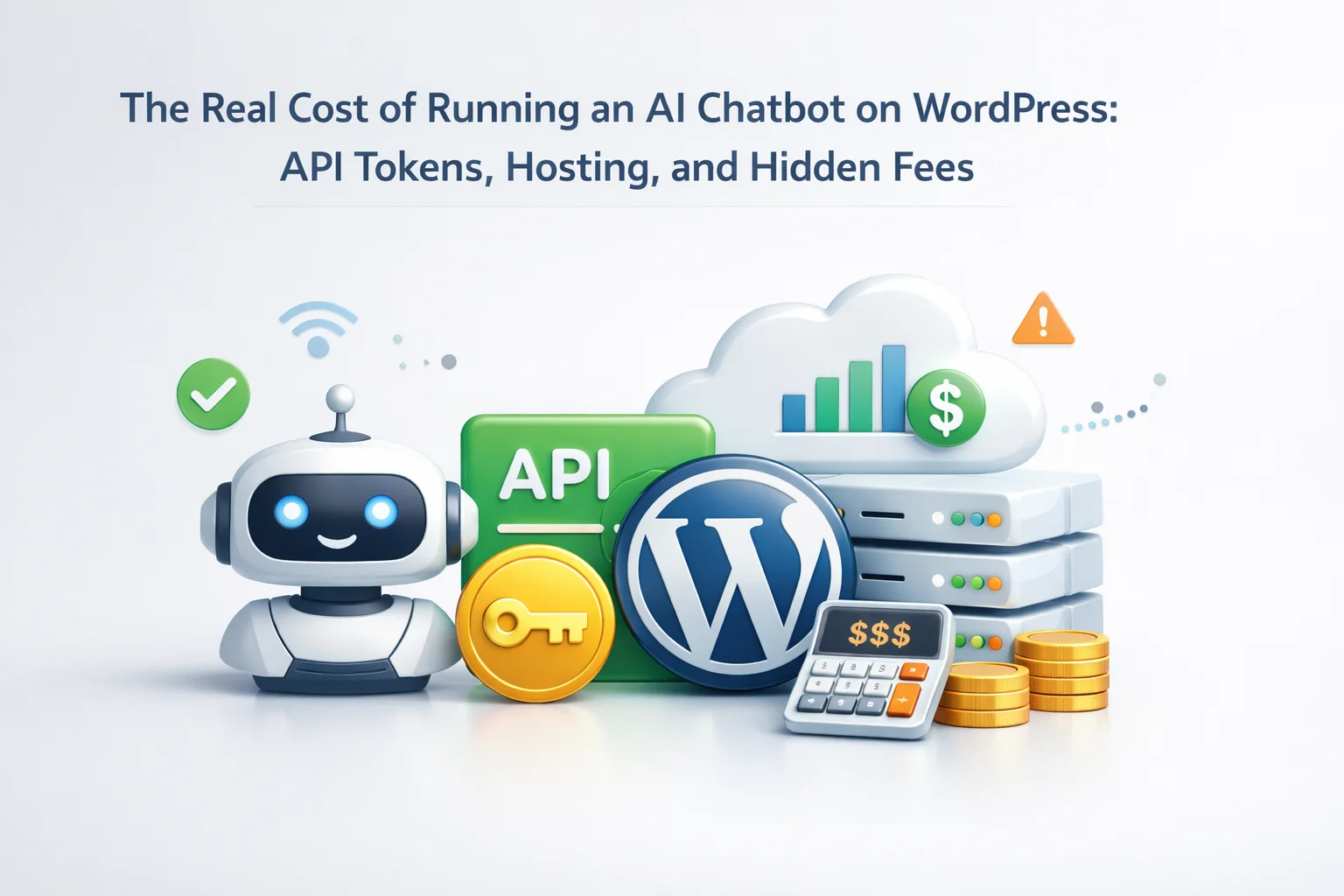
A client called me last month with a problem that has become increasingly common. They installed an AI chatbot plugin on their WordPress site, attracted by the promise of automated customer support. The plugin was free. The setup took ten minutes. Everything worked perfectly for about two weeks. Then they got their first OpenAI bill: two hundred and thirty-seven dollars for a single month on a site that gets maybe five thousand visitors.
They had no idea this was coming. Nobody told them that every chatbot message triggers an API call that costs money. Nobody explained that the “free” plugin was just a conduit to a paid API service. Nobody mentioned that chatbot visitors tend to send far more messages than anyone anticipates, and that each message includes conversation history that multiplies the token count.
This story plays out constantly because the AI chatbot market has a transparency problem. Plugin listings emphasize features and downplay costs. Pricing pages show per-token rates that mean nothing to someone who has never calculated token usage. The hidden fees and infrastructure requirements are buried in documentation that most people never read.
This guide breaks down every cost component of running an AI chatbot on WordPress. No vague estimates. No marketing language. Just the actual numbers so you can budget accurately before you deploy, not after you get a surprise bill.
Understanding API token costs: the biggest expense you will face
API tokens are the primary cost driver for any AI chatbot. Every word your chatbot reads and writes costs money. Not a lot per word, fractions of a cent, but it adds up faster than most people expect.
A token is roughly four characters of English text, or about three-quarters of a word. When a user sends a message to your chatbot, that message gets converted to tokens. The chatbot’s response also gets converted to tokens. But here is what catches people off guard: the conversation history also gets sent with each request, and that history grows with every exchange.
A single question-answer exchange might use 500 tokens. But by the tenth message in a conversation, each new exchange might use 3,000 tokens because all previous messages are included for context. This is why chatbot costs scale non-linearly with conversation length. Five short conversations cost less than one long conversation with the same total message count.
500 tokens
1,500 tokens
4,000 tokens
2,000 tokens
One-fifth of a cent sounds negligible. But 1,500 conversations per month equals $3. With GPT-4o instead of mini, the same volume costs $50. With longer conversations or higher traffic, costs multiply quickly. The client who got the $237 bill had about 3,000 conversations using GPT-4 (the older, more expensive model) with long conversation contexts.
Embedding costs: the hidden fee for smart chatbots
If your chatbot uses RAG (retrieval-augmented generation) to answer from your website content, there is another cost: embeddings. Your content must be converted to vectors for semantic search. This happens during initial indexing and when content updates.

Embedding costs are lower than completion costs. OpenAI’s text-embedding-3-small costs $0.02 per million tokens. A site with 100 pages costs about $0.03 to fully index. The real issue is inefficient plugins that re-embed unchanged content. A well-designed WordPress AI chatbot with smart content indexing only re-embeds content that actually changed.
Plugin costs: understanding the pricing models
AI chatbot plugins use three main pricing models, each with different cost implications.
You use your own API key and pay providers directly at their rates. Plugin charges one-time or annual fee ($49-199 typical). No per-message markup. Most cost-effective for sites with more than 200-300 conversations monthly. Full cost transparency and control.
Everything bundled into monthly fee ($29-299). Includes API, hosting, features. Easier to budget but typically more expensive at scale. Often includes message limits. Good for sites wanting simplicity over optimization.
Free tier with 50-100 messages monthly. Enough to evaluate, not enough for production. Designed to convert you to paid plans. Useful for testing before committing, not for actual deployment.

Hosting costs: when your current plan fails
AI chatbots add server load that basic shared hosting struggles with. Each interaction involves PHP processing, database queries, and waiting for API responses. Budget hosting that works for simple WordPress sites can buckle under chatbot load.
Chatbot requests hold PHP workers 2-10 seconds while waiting for API. Cheap hosting with 2-4 workers gets blocked by few concurrent users. Need 8-12 workers minimum. Upgrade cost: $20-50/month.
Conversation logging and vector storage add database load. Shared database servers cause slow responses. Sites with heavy chatbot usage need dedicated database resources. Add $10-30/month.
Vector operations and context management consume RAM. PHP memory errors during chatbot use mean you need higher memory allocation. Expect $5-15/month more for adequate memory.
Hidden fees most people miss
Beyond obvious costs, several hidden expenses catch site owners off guard.
Some plugins use external vector databases like Pinecone. Production usage costs $70-700/month. Other plugins store vectors locally, avoiding this cost with some performance trade-offs.
One-time purchase plugins often have 30-50% annual renewals for updates. A $99 plugin with $49 renewals costs $247 over three years. Factor renewals into total cost of ownership.
Chatbots need ongoing attention: updating knowledge, refining prompts, reviewing conversations. Budget 2-4 hours monthly. At typical rates, that is $50-200/month in labor costs.
Real monthly cost scenarios
Here are realistic total costs based on actual WordPress sites I have worked with.

Strategies to control costs

GPT-4o-mini handles most FAQ-style interactions excellently at 1/15th the cost of GPT-4o. Reserve expensive models for complex reasoning only.
Set per-user limits: 50 messages/session, 100/hour, 200/day. Prevents abuse and runaway costs from curious users treating your chatbot as entertainment.
Include only last 5-10 messages instead of entire history. Provides adequate context while cutting token usage significantly in longer conversations.
Configure API provider alerts at 50% and 80% of budget. Set hard limits that pause the chatbot rather than allowing unlimited spending.
Is the cost worth it?
A chatbot costing $100/month that saves $300 in support labor or generates $500 in sales is excellent ROI. The break-even comes when chatbot handles enough interactions to offset what human support would cost for the same volume.
If your chatbot handles 200 conversations monthly that would otherwise need 5-minute email responses from $25/hour support staff, that is $400 of labor value. Even at the high end of cost scenarios, the math works for sites with meaningful chatbot engagement.
The key is deploying a chatbot that actually resolves questions. A poorly configured chatbot adds cost without reducing support load. A well-configured WordPress AI chatbot with proper content indexing genuinely deflects support volume and delivers positive ROI.
Know exactly what your AI chatbot costs
SmartChat Assistant uses transparent BYOK pricing. Pay API providers directly with no markup. Built-in rate limiting and usage monitoring help control costs from day one.

Finally, real numbers before buying
Wow, this saved me from a nasty surprise! finally someone shows the real numbers not just that "starts
Hey everyone! just wanted to drop a quick note about this cost guide it's a lifesaver. I manage a few WordPress sites, and the "free" AI chatbot plugins had me worried after seeing unexpected bills pop up. this breakdown finally lays out the real costs (API tokens, hosting bumps, etc.) in plain terms
Got hit with a $237 bill after just