Next-Level Code. Nexuvibe Style ...
Hrs
Min
Sec

There are thousands of WordPress sites running multilingual content that was translated in 2023 or 2024 using whatever was available at the time: Google Translate through WPML credits, an early version of DeepL, or a budget translation service. That content is live. It is indexed by Google. Visitors are reading it every day. And by the standards of what AI translation can produce in 2026, a significant portion of it reads awkwardly, misses context, and underperforms in search results compared to what is possible now.
The question these site owners face is practical: is it worth re-translating existing content with better models, and if so, how do you do it efficiently across hundreds or thousands of pages without breaking your live site, losing your search rankings, or spending weeks on manual work?
The answer to the first question is almost always yes. The answer to the second is the subject of this guide.
The improvement in AI translation quality between 2023 and 2026 is not incremental. It is a generational leap. Content that was translated with Google Translate NMT three years ago and seemed acceptable at the time now reads noticeably worse when compared side-by-side with output from Claude Sonnet 4.6 or GPT-4o. The gap is visible to any native speaker within a few sentences.
This matters for three concrete reasons that affect your business.
Google’s helpful content system now explicitly evaluates whether content reads naturally and provides genuine value. Translations that sounded passably machine-generated in 2023 may now be actively disadvantaged in rankings compared to competitors who use modern AI translation. Re-translating with better models does not just improve readability. It can improve your search rankings for translated content.
Visitors in 2026 are exposed to higher-quality machine-translated content across the web. The bar for what reads as acceptable has risen. Content that felt “fine for a translation” three years ago now feels dated and unprofessional compared to competitors who have upgraded. If your competitors re-translate with modern AI and you do not, the quality gap between your sites becomes a trust gap.
Most WordPress sites update their content over time: revised product descriptions, updated blog posts, refreshed landing pages. If the English source has changed since the translation was created, the translated versions are now out of date. They show old information in the target language while the English version shows current information. Re-translating brings everything back in sync with the current source content.
The fear most site owners have about bulk re-translation is breaking something on their live site. Losing existing translations that are “good enough.” Creating temporary gaps where pages show untranslated content. Messing up URL structures or losing indexed pages. These are legitimate concerns, and the approach matters.
The key principle is that re-translation through WPML overwrites the existing translation content but preserves the translation structure. Your translated page’s URL stays the same. Its relationship to the original language version stays the same. Its position in WPML’s translation management stays the same. Only the text content is replaced with the new, higher-quality translation. From Google’s perspective, the URL returns the same page with improved content, which is exactly how a content update should work.
Here is the process for upgrading your existing translations to modern AI quality using the bulk re-translation tools.
Not all pages need immediate re-translation. Start by identifying the content that matters most: your highest-traffic pages (check Google Analytics), your money pages (product pages, landing pages, pricing pages), and your homepage. These are the pages where improved translation quality directly affects revenue and engagement. Low-traffic archive pages and old blog posts can wait for a later batch.
Pick a few representative pages from your priority list. Re-translate them through the AI addon and compare the output against the existing translations. This gives you a concrete quality comparison and confirms that the re-translation process works correctly for your specific content types. If the improvement is marginal (which is rare when upgrading from Google Translate to Claude or GPT-4o), you save the effort of bulk re-translation. If it is dramatic (which is the usual outcome), you have the evidence to justify the time investment.
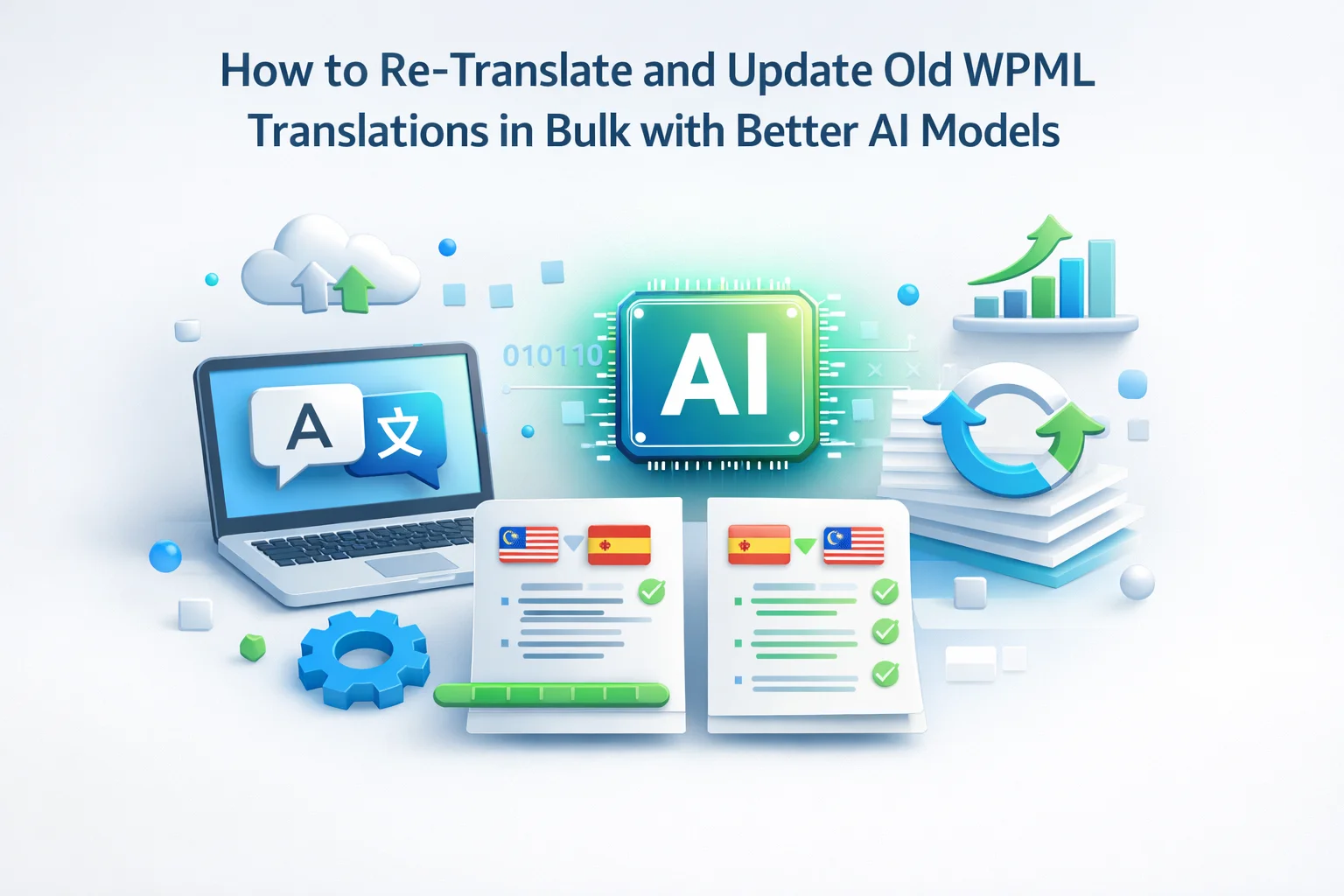
The NEXU AI Auto Translator for WPML includes dedicated bulk re-translation tools that let you select multiple posts, pages, or products and retranslate their titles, content, and custom fields across all active languages in a single operation. Navigate to the plugin’s bulk tools section, select the content type you want to retranslate, choose the specific items, and run the re-translation. The plugin sends each item through the AI translation pipeline and overwrites the existing translations with the new output.
Do not forget the supporting content. Product categories, navigation menus, widget titles, and WPML string translations were also translated with the old method and will also benefit from re-translation. The bulk tools include separate options for category re-translation and string re-translation. Run these after your main content is updated so the entire site experience is upgraded consistently.
After re-translation, spot-check a sample of pages across each language to confirm the quality improvement. Then monitor your Google Search Console performance for the translated pages over the following weeks. You should see improvements in click-through rates (because meta descriptions are now better) and potentially in rankings (because content quality has improved). The improvement is usually visible within two to four weeks as Google recrawls and reindexes the updated translations.
If you or a human translator manually edited some translations after the initial machine translation, re-translating those pages will overwrite those manual edits. This is the one scenario where you need to be careful.
The practical approach is to exclude manually-edited pages from the bulk re-translation and handle them individually. If the manual edits were minor (fixing a few phrases), the AI re-translation will likely produce better overall quality than the partially-edited machine translation, and you may decide the AI version is an improvement even without the manual tweaks. If the manual edits were extensive (a professional translator rewrote significant portions), keep those pages as-is and only re-translate the purely machine-translated pages.
If you are unsure which pages were manually edited, WPML’s translation editor shows the modification history for each translated page. Check the last modified date and compare it to the original translation date. If the translated page was modified after its initial creation, someone likely edited it manually.
Re-translating existing content uses the same API pricing as initial translation. There is no premium for overwriting existing translations. Here is what the re-translation costs for typical site sizes, assuming you already have the plugin license.
For most sites, the re-translation cost is under $20. Even for the largest scenario (3,000 items across 8 languages), the cost is $273, which is a one-time investment to upgrade your entire multilingual content library to 2026-quality AI translation. Compare that to hiring human translators to review and update the same volume, which would cost $15,000 to $50,000 depending on language pairs and rates.
The processing time for large re-translations is measured in hours to days because the plugin processes items sequentially through WordPress cron. This is not something you need to monitor actively. Start the batch, let it run in the background, and check back periodically. The content updates seamlessly on your live site as each item completes.
If you are upgrading from Google Translate, any modern AI model will be a significant improvement. But if you want to optimize further, match the model to your language mix based on the testing data from our comparison articles.
Use Claude Sonnet 4.6 for the best naturalness and tone preservation. GPT-4o is a close second. Either one represents a massive upgrade from Google Translate for European languages.
Use Mistral Large. It produces the most natural Arabic sentence structure. The improvement over Google Translate Arabic is particularly dramatic because Arabic is one of the languages where Google Translate struggles most with natural sentence flow.
Use GPT-4o. It handles non-European languages with the most consistency, particularly for Japanese where correct honorific register and kanji compound selection matter.
Switch models between batches. Re-translate your French, German, and Spanish content with Claude. Switch to Mistral and re-translate Arabic. Switch to GPT-4o and re-translate Japanese. The plugin lets you change AI providers in settings between batches without any reconfiguration. This per-language optimization is one of the key advantages of using a multi-provider translation addon.
Re-translation is not just a one-time cleanup task. AI models improve with each major update. What is the best available model today will be surpassed within 12 to 18 months. Building a maintenance schedule into your multilingual content strategy ensures your translations stay at the quality frontier rather than falling behind.
Every three months, retranslate your highest-traffic and highest-revenue pages. These are the pages where translation quality has the most direct impact on your business. If a new AI model version has been released since your last re-translation, use it. The cost for 20 pages across a few languages is under $1 in API fees. The potential improvement in engagement and conversion makes this an absurdly high-ROI maintenance task.
Once a year, do a complete re-translation of your entire multilingual content library. AI models improve enough each year that a full sweep is justified. It catches any content that has drifted out of sync with the English source, upgrades the translation quality to the latest model capabilities, and ensures consistency across your entire site. The cost for even a large site is under $100 in API fees.
Whenever you significantly update a page or product in your default language, re-translate it immediately. Do not let updated English content sit alongside outdated translations. WPML marks translations as “needs update” when the source content changes, making it easy to identify which pages need re-translation. The plugin’s bulk tools can filter for these “needs update” items specifically.
Your translated content is not a static deliverable that you create once and forget. It is a living asset that degrades over time as AI technology advances, source content evolves, and user expectations rise. Treating your translations as a maintenance responsibility rather than a completed project is what separates multilingual WordPress sites that perform well from those that quietly underperform in international markets.
The cost of maintaining translation quality is negligible with modern AI. A few dollars in API fees and a few minutes of configuration give your entire multilingual content library a quality upgrade that would have cost thousands of dollars in human translation work just a few years ago. The tools exist to make this maintenance effortless: bulk re-translation, per-language model optimization, background processing that runs while you sleep.
If your site has translations from 2023 or 2024, they are almost certainly holding back your international search performance and user engagement. The upgrade path is clear, the cost is trivial, and the improvement is immediate. Your multilingual visitors deserve content that reflects the best of what is available today, not the best of what was available when you first set up your translations.
Bulk re-translation tools for posts, products, categories, and strings. Four AI providers. Switch models per language. Background processing. From $39/year.






Just updated my medical practice's Spanish pages with this bulk re translation tool, and wow the difference is night and day. The readability is so much better now; patients actually get the nuance instead of those awkward, word for word translations we had before.
Does this update the translations without altering the original English text? need to keep source intact.
Just wanted to share my experience with this bulk re translation guide. As a musician with a multilingual site for my gigs and lessons, I had a bunch of pages translated back in 2023 using WPML credits