Next-Level Code. Nexuvibe Style ...
Hrs
Min
Sec

The question “how much does WPML translation cost?” does not have a single answer. It depends on which translation method you use, how much content you have, how many languages you target, and whether you need ongoing translation for new content. Most articles about WPML translation costs give you the pricing tiers from WPML’s website and stop there. That is not useful because it does not tell you what the actual cost will be for a real site with real content volumes.
We took four real website profiles, representing the most common types of WordPress sites that need multilingual translation, calculated the content volume for each, and priced out the cost across three methods: WPML’s built-in credit system, AI translation through your own API keys, and professional human translation. The results make the economics of each approach very clear.
Every number in this article is based on actual pricing from April 2026. AI API costs change periodically, so specific dollar amounts may shift by the time you read this. The relative comparisons between methods will remain broadly accurate because the underlying cost structures are stable.
These profiles are designed to represent the range of WordPress sites that typically need multilingual translation. Your site probably resembles one of them closely enough that the cost estimates will be useful for your budgeting.
A personal or small business blog with about 50 existing posts averaging 1,000 words each. Translating into 3 languages means 150,000 words of initial translation, plus roughly 12,000 words per month for new posts. Includes 10 static pages (about, contact, services) with an average of 500 words each.
An online store with 200 products averaging 350 words each (title, descriptions, SEO meta). Translating into 5 languages means 350,000 words initially. Monthly new content: 10 new products (17,500 words) plus occasional blog posts. Also includes 20 category descriptions and 15 static pages.
A media site or authority blog with 500 long-form posts averaging 1,500 words. Translating into 4 languages means 3,000,000 words of initial translation. Monthly new content: 12 posts (72,000 words across all languages). This is where translation costs become a serious line item in the budget.
A WordPress agency that manages 10 client sites, each with an average of 40 pages of content (about 400 words each). Each site translates into an average of 3 languages. Total initial translation: approximately 480,000 words. Monthly new content varies by client but averages about 20,000 words across all sites.
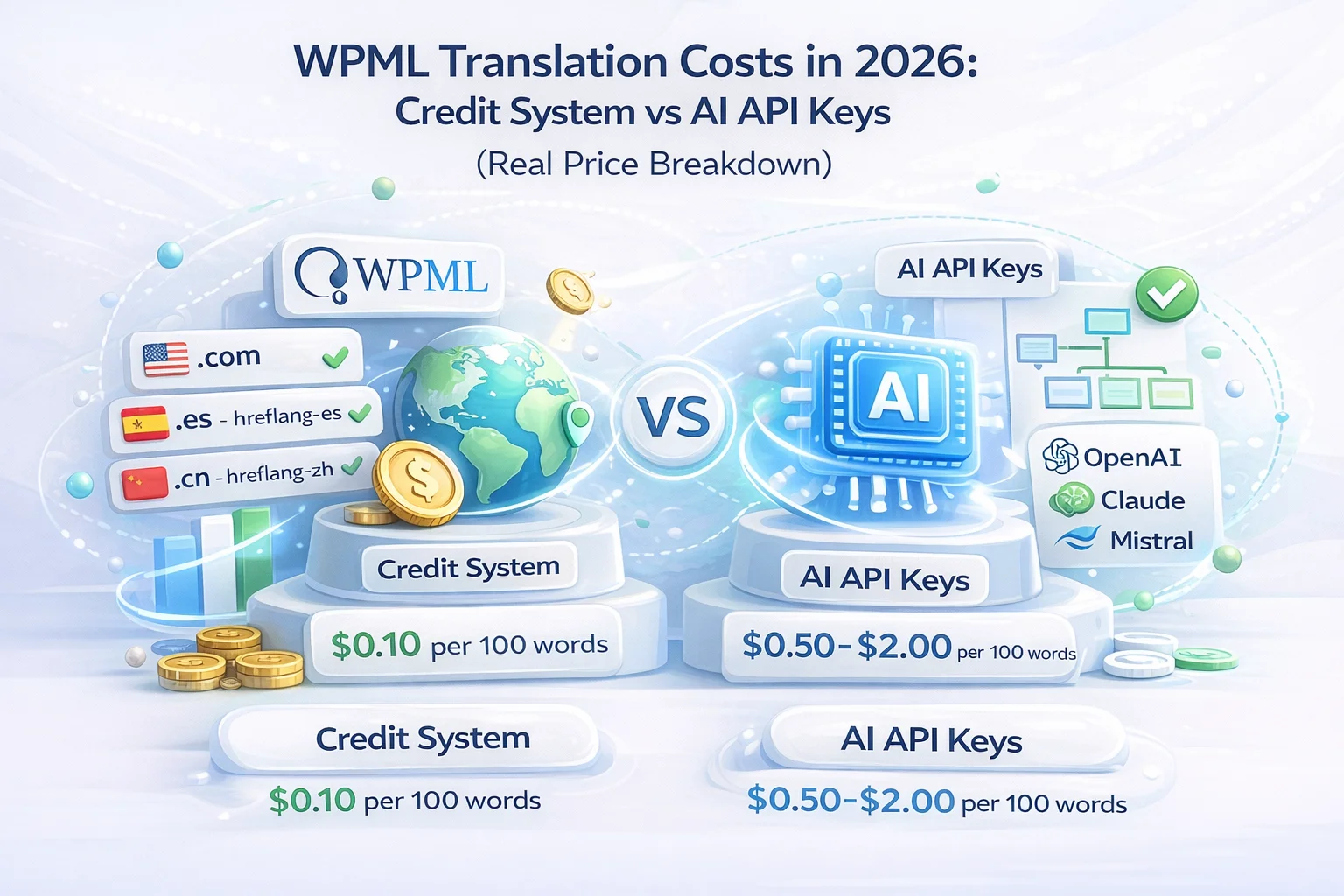
WPML sells translation credits in bundles. At the time of writing, the pricing tiers are approximately $29 for 90,000 words, $79 for 270,000 words, and $159 for 720,000 words. These credits are used when you send content through WPML’s built-in automatic translation service, which routes your content through machine translation engines like Google Translate, DeepL, or Microsoft Translator.
The per-word cost works out to approximately $0.32 per 1,000 words at the smallest tier and $0.22 per 1,000 words at the largest tier. These are competitive rates for machine translation, but the cost adds up quickly for large content volumes, especially when translating into multiple languages.
The credit system’s strength is simplicity. You buy credits, press translate, and it works. There are no API keys to manage, no external accounts to set up, and no addon plugins to install. The trade-off is higher per-word cost, reliance on traditional machine translation engines rather than modern AI models, and a credit balance that drains faster than most people expect when translating into multiple languages.
The alternative approach is connecting your own AI API key to WPML through an addon plugin. You pay the AI provider’s raw API rate with no markup, plus the annual license for the addon. The per-word costs through AI APIs are dramatically lower than WPML credits, and the translation quality from models like GPT-4o and Claude Sonnet 4.6 generally exceeds traditional machine translation.
For this comparison, we calculated costs using OpenAI’s GPT-4o pricing (approximately $2.50 per million input tokens, $10 per million output tokens) and assumed a $39/year single-site addon license or $399/year for the agency 20-site license. Costs with Claude, Mistral, and Grok are in a similar range, with Mistral being slightly cheaper and Claude being roughly comparable to OpenAI.
The numbers are stark. For every site profile except the agency scenario at the initial license cost level, the AI API approach costs less in the first year. And the gap widens dramatically in the second year and beyond, because the API costs are the only recurring expense (the plugin license renews but the API costs stay at pennies per thousand words).
The agency scenario deserves a note: the $399 20-site license looks expensive compared to $224 in WPML credits for the first year. But that $399 covers 20 sites. As the agency adds content across those sites, the credit costs grow proportionally while the plugin license stays fixed. By the end of the first year, the API approach is already cheaper. By year two, it is dramatically cheaper.
For completeness, here is what the same translation volumes cost with professional human translators. We used average rates from ProZ and Upwork for general content translation: approximately $0.08 to $0.12 per word, varying by language pair and subject matter.
These numbers explain why most WordPress site owners do not use professional human translation for their entire site. It is economically viable only for businesses with international revenue that justifies the investment: large e-commerce stores, SaaS companies, and enterprises with dedicated localization budgets. For everyone else, AI translation with selective human review of critical pages is the practical approach.
Here is the summary table that puts all three methods next to each other for each site profile. First-year total costs only.
The AI API approach wins decisively for individual sites at every size. The only scenario where WPML credits are cheaper in year one is the agency profile, and that flips by year two as ongoing API costs stay minimal while credit costs accumulate. By year three, the AI approach is cheaper for every profile without exception.
The tables above show direct translation costs. There are indirect costs that change the picture further.
WPML credits and AI addons both automate the translation process. Human translation requires managing translators, briefing them on your brand voice, reviewing their work, and coordinating delivery timelines. For the agency profile, translator management can easily add 5 to 10 hours per month of project management time that does not appear in the price per word.
When you update a product description or revise a blog post, the translation needs updating too. With WPML credits, re-translating updated content costs the same per-word rate as translating it the first time. With AI APIs, re-translation costs are negligible. With human translators, re-translation often costs 50 to 75 percent of the original translation fee. Over a year of regular content updates, re-translation costs can add 20 to 40 percent to your total.
The most expensive option is often not translating at all. A WooCommerce store that does not translate into the languages its customers speak leaves revenue on the table. Studies consistently show that consumers are far more likely to purchase from sites in their native language. The cost of translation should be weighed against the revenue opportunity of reaching international markets, not just against other translation methods.
The data points clearly toward AI API translation for the vast majority of WordPress sites. It offers the lowest cost at every content volume, the best quality-to-cost ratio with modern AI models, and complete automation from content creation to published translation. The $39/year addon cost is the price of a single large WPML credit bundle, and it unlocks unlimited translation volume at API rates that are 90 to 95 percent cheaper per word.
WPML credits make sense if you value simplicity above everything else, translate small volumes occasionally, and do not want to manage an API key. There is nothing wrong with choosing convenience over cost optimization if your translation budget is small enough that the difference does not matter.
Human translation makes sense for high-value content where precision and cultural nuance directly affect revenue: product pages for luxury brands, legal disclaimers, marketing campaigns targeting specific regional markets, and any content where a single translation error could damage trust or create liability.
The approach we recommend most often is AI translation for everything with selective human review for your top 10 to 20 most important pages. This gives you full coverage at AI costs, with professional-grade quality on the pages that matter most. NEXU AI Auto Translator for WPML handles the automated side of this equation, and the human review can be done through any freelance translator working in WPML’s translation editor.
Connect your own AI API key to WPML. Translate at raw API rates with no markup. OpenAI, Claude, Mistral, or Grok. Background processing. From $39/year.

This breakdown finally gave me the real numbers I needed! We're launching a multilingual blog with 5 languages, and the 350k initial word count was spot on for our content volume. The cost comparison saved me hours of guessing no hidden API fees, no surprise markups, just straight pricing
Finally found a breakdown that actually shows real numbers instead of just listing those vague WPML pricing tiers. The way they compared credits, API keys, and human translators for actual site volumes was exactly what I needed to budget for my client's multilingual blog. No fluff, no marketing speak just the math laid out clearly. such a relief to see someone actually do the legwork on how costs shake out for different site sizes. Seriously saved me hours of guessing and second guessing
Hey everyone, quick question if I'm translating a site with 350k words into 5 languages, does WPML's credit system actually work out cheaper than just using my own AI API keys?