
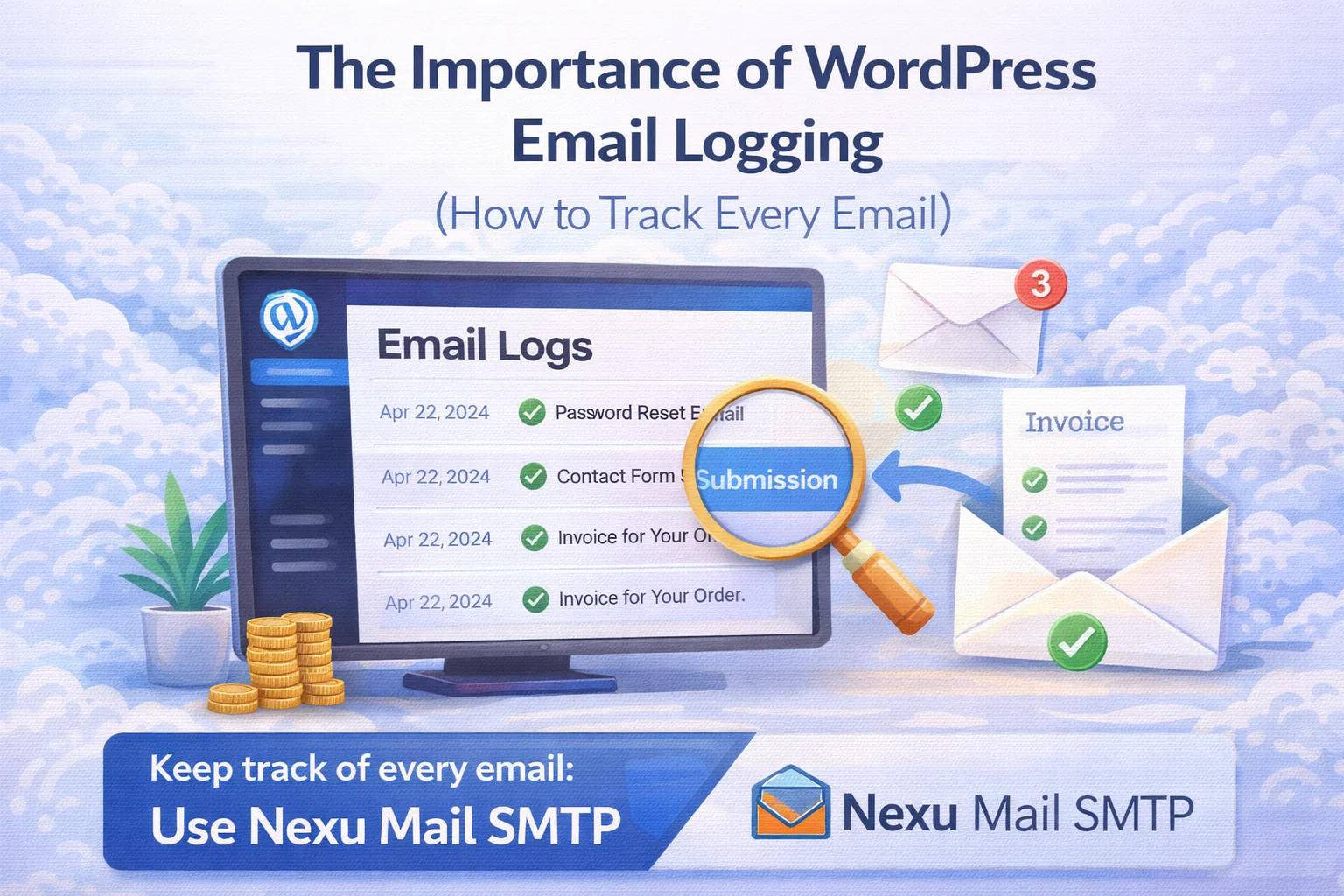
Think about what your WordPress site sends in a typical week. Password reset requests for users who forgot their credentials. Order confirmations for every purchase made through your WooCommerce store. Shipping notifications when orders are dispatched. Contact form notifications when a potential client submits an enquiry. New user registration welcome emails. Refund confirmations. Admin alerts when something significant happens on the site.
Now ask yourself a different question: how many of those emails actually reached their destination this week? Not how many were sent. WordPress considers an email sent the moment it hands it off to the server. How many were delivered, opened, and acted on by the person who was supposed to receive them? For most WordPress site owners, the honest answer is: they have no idea. There is no record. There is no log. There is no visibility into any of it until something breaks and a customer complains.
This is the email logging problem. It is not talked about as much as the email delivery problem, the familiar story of emails going to spam or not sending at all, but it is in many ways more dangerous, because it is completely invisible. You can be losing a meaningful percentage of your business communications to failed or filtered emails right now, and your WordPress dashboard will show absolutely no indication that anything is wrong.
This guide covers what email logging is, what specific information a good email log captures, every situation in which that information proves genuinely valuable, and how to implement it on your WordPress site in a way that gives you complete visibility without adding operational complexity.
What WordPress email logging actually means
Email logging, in the WordPress context, means maintaining a persistent record of every email that WordPress attempts to send through the wp_mail() function. This record is stored in your WordPress database and accessible from your admin dashboard, giving you a searchable history of all outgoing email activity.
By default, WordPress has no email logging whatsoever. The WordPress developer documentation for wp_mail() confirms there is no native logging built into core. When an email is sent, it is handed off to the server and forgotten. There is no record in the database, no status indicator, no way to know after the fact whether the email was sent, failed, delivered, or bounced. The email is gone from WordPress’s perspective the moment the send function is called.
A WordPress email log is implemented through a plugin that hooks into the wp_mail() function (see the WordPress developer reference ) and records each outgoing email before it is dispatched. The best implementations record the full email content, the recipient, the subject, the sending timestamp, any CC or BCC addresses, and the outcome of the send attempt. This gives you a complete audit trail of all email activity on your WordPress installation.
The seven situations where an email log proves its value immediately
It is easy to describe email logging in abstract terms and harder to convey why it matters concretely. The clearest way is to walk through the specific real-world situations where a log makes an immediate, tangible difference, and what happens in each of those situations when you do not have one.
You cannot confirm whether the email was sent, which address it went to, or what happened after it was handed off to the server. You apologize, resend manually from the WooCommerce order screen, and hope it works. The customer’s confidence in your store is damaged. You have no data to determine whether this is an isolated incident or a systemic problem.
You search the log by the customer’s email address, confirm the order confirmation was sent at a specific time, check its delivery status, and if it failed for any reason, resend it in one click. The resolution takes under two minutes. If the email was delivered successfully but the customer cannot find it, you can tell them the exact time it was sent so they know where to look.
You try resending the password reset from the WordPress admin, suggest they check their spam folder, and if it still does not arrive, you manually reset their password and send it in plain text, a security practice you should never be in the position of needing to use. If this happens to multiple users on the same day, you have no way to detect the pattern.
You immediately check whether a password reset email was attempted and what happened, was it sent successfully, did it fail, was it sent to the correct address? If the SMTP connection failed, you can see the error and fix it. If the email was sent but not received, you can point the user to the exact time it was sent. Patterns of failure become visible in minutes rather than days.
You stop receiving new order admin alerts but have no way of knowing this has happened. Orders are being placed, the store is processing them, but you are not aware because the notification pipeline is broken. You discover the problem when a customer emails you separately after waiting for a response that was never coming. By then, you may have missed multiple urgent orders.
The email log shows a sudden pattern of failed send attempts with an authentication error, starting from the exact moment the credentials expired. If you have failure alerts configured, you are notified immediately. Even if you check the log reactively, you can see exactly when the failure started, which orders were affected, and resend all the admin notifications in one batch once the SMTP connection is restored.
A plugin update conflicts with your SMTP configuration. Email stops going out. Nobody notices for three days because the dashboard looks normal and no customers complain immediately. By the time the problem surfaces, three days of contact form submissions, order notifications, and account registrations have been silently lost.
The log shows zero email activity starting from the exact time of the update. If you have failure alerts active, you are notified within minutes. Even checking the log at the end of the day reveals the problem immediately. The break is caught on day one rather than day three, and the emails that failed can be identified and resent.
Site migrations often break email configuration. PHP mail settings differ between hosts. SMTP plugins may not carry over their settings correctly. Without a log, you have no way to confirm whether email is working on the new host until a customer complains, which on a busy WooCommerce site can mean hours of failed order confirmations before the problem surfaces.
Post-migration verification becomes a two-minute checklist item. Send a test email, check the log to confirm it recorded and shows a successful delivery status. If it fails, the error is right there in the log. Before going live, you have confirmed that every email type is working correctly on the new hosting environment. Migration risk is reduced to near zero.
You know you processed the refund in WooCommerce. The WooCommerce order shows Refunded status. But you have no proof that the refund confirmation email was sent, no timestamp, no delivery record, no message content. In a payment dispute, this gap in documentation works against you. The customer’s word against yours, with no verifiable paper trail.
You pull the log entry for that refund confirmation: exact timestamp, recipient address, message content, and delivery status. This is verifiable documentation that the email was sent. In a payment dispute, this kind of timestamped record is exactly what payment processors ask for. The log entry, combined with the WooCommerce order record, gives you a complete documented trail.
GDPR’s accountability principle (defined under Article 5 of the GDPR regulation ) requires that you can demonstrate how personal data is being processed. If a regulator asks for evidence that you sent a required notification, a data breach notification, a terms update notice, a consent confirmation, you have nothing to show. “We sent it” is not documentation. A WordPress site with no email log has a genuine compliance gap.
The email log is your audit trail. Every notification sent, timestamped and searchable. For GDPR compliance and for any situation where you need to demonstrate that specific communications were made, the log provides verifiable, exportable documentation. It is the difference between claiming you did something and being able to prove it.
What a genuinely useful email log records
Not all email logs are created equal. Some record only the most basic information, subject line and timestamp, which is barely better than nothing when you actually need to investigate a problem. A genuinely useful email log captures enough information to answer every question you might need to ask about a specific email.

The one feature that separates a useful log from a basic one: resend
A log that only records is useful. A log with resend capability built in is transformative. The difference between them is the difference between a forensic record and an operational tool.
When an email fails or is reported missing, a record-only log tells you it happened and shows you the details. But the next step, getting that email to the recipient, still requires going somewhere else: back to the WooCommerce order to trigger a resend, or back to the form plugin, or manually composing a replacement. Each of those steps adds time and introduces the possibility of error.
With resend capability in the log, the entire resolution workflow happens in one place. A customer reports a missing email. You open the email log, find their entry using the search or filter, verify the details, and click Resend. The original email, with the original content, recipient, and subject, is resent immediately through your current SMTP configuration. The customer receives the email within seconds. The support interaction is resolved in under two minutes from a single screen.

Email logging and GDPR: the compliance dimension
For any WordPress site processing personal data, which, in practice, means almost every site with user accounts, contact forms, or a WooCommerce store, email logging has a compliance dimension that deserves its own consideration.
GDPR’s accountability principle requires that controllers be able to demonstrate compliance, not just claim it. The full text of GDPR Article 5 lays out these accountability requirements in detail. When it comes to email communications that involve personal data, order confirmations that contain customer details, refund notifications, account management emails, an email log provides the documentation trail that supports that demonstration. It shows when communications were sent, what they contained, and that the processing was taking place in an organized, accountable way.
There is also the subject access request dimension. Under Article 15 of GDPR, individuals can request access to their personal data, which may include records of email communications sent to them by your site. An email log makes responding to these requests straightforward, you search by the requestor’s email address and export their entries. Without a log, you have nothing to provide.
Email logs contain personal data, recipient email addresses, names embedded in email content, which means GDPR’s storage limitation principle applies. Logs should be retained long enough to serve their operational and compliance purposes (typically 90 days for operational use, longer where specific regulations apply) and should be automatically pruned after that period. A well-configured email log plugin handles this automatically with a configurable retention period, so the log stays useful without accumulating personal data indefinitely.
How to implement WordPress email logging today
Setting up an email log on your WordPress site is not a complex technical undertaking. The practical steps are straightforward and take under thirty minutes from start to first logged email.
The most efficient approach is a plugin that handles both SMTP configuration and email logging in a single installation. Nexu Mail SMTP’s integrated email log and SMTP delivery plugin gives you reliable delivery and complete logging in one coherent tool, no need to install a separate logging plugin on top of a separate SMTP plugin, which can create conflicts and double the maintenance surface.
Set a retention period before any emails are logged so that personal data accumulation is managed from day one. For most sites, 90 days is an appropriate starting point, long enough to be useful for investigating delivery problems, short enough to comply with data minimization principles. Sites with specific regulatory requirements may need to adjust this. Document your retention decision and the justification for it in your data protection records.
Configure failure alerts to notify you (by email or another channel) the moment an email send attempt fails. This transforms the log from a reactive investigation tool into a proactive monitoring system. Rather than discovering a broken SMTP configuration when a customer complains, you receive a notification within minutes of the first failure and can address it before it affects your users.
An email log is most valuable when it is checked proactively, not just reactively. Building a brief weekly habit of reviewing the log, looking for unusual patterns, checking failure rates, confirming that expected email types are appearing, means you catch problems weeks before they would surface through customer complaints. On a busy WooCommerce site, this weekly check takes under five minutes and can prevent days of undetected delivery failures.
Every WordPress site sends email. Every WordPress site therefore has email risk, the possibility that those emails are not arriving, that they are being silently filtered, that a configuration change has broken the pipeline, or that a specific user is having a delivery problem that nobody knows about. Email logging is the only way to convert that risk from invisible to visible and manageable.
The operational cost of implementing logging is minimal: one plugin, thirty minutes of setup, a brief weekly check. The cost of not having it is measured in missed enquiries, payment disputes without documentation, customer trust damaged by communication failures that could have been caught and resolved in minutes, and compliance gaps that create exposure in a regulatory environment that is increasingly specific about accountability for data processing. For any site where email is a meaningful part of how the business operates, the decision is not really a close call.
Stop running your WordPress site blind. Start knowing exactly what your site is sending.
Nexu Mail SMTP combines authenticated SMTP delivery with a complete email log, resend capability, and failure alerts, everything you need to run your WordPress email with full visibility and zero blind spots.




I've been using WordPress for years, and I'm really frustrated with how this email logging plugin handles refund confirmations. As someone who runs an online store, these emails are everything they're how customers know they can trust me. but right now, there's no good way to check if they actually went out unless a customer complains first. That's a huge problem. I set everything up exactly like the guide said, but when a customer asked about their refund status, I had no way to confirm if the email even sent
Hey, the GDPR features are handy, but setup took way longer than I thought it would.
Hey everyone, I picked up this email logging guide kind of on impulse, and man didn't realize how much I was missing until now. The part that really got me was where it lays out exactly why unlogged emails are basically a disaster waiting to happen (and then shows you how to fix it in 10 minutes).